Why Temperature Shifts Viscosity 5×—and >8 mm Chunks Destroy Lobe Pumps
Testing a tomato pasta sauce or BBQ glaze at 22 °C room temperature misleads equipment sizing completely: at 85 °C hot-fill kettle temperature, viscosity drops 3× to 6× (causing thin nozzles to drip!), while liquid density drops ~3%—meaning 500 ml dosed at 85 °C shrinks visibly inside the bottle neck once cooled to 25 °C unless piston stroke compensates for thermal contraction.
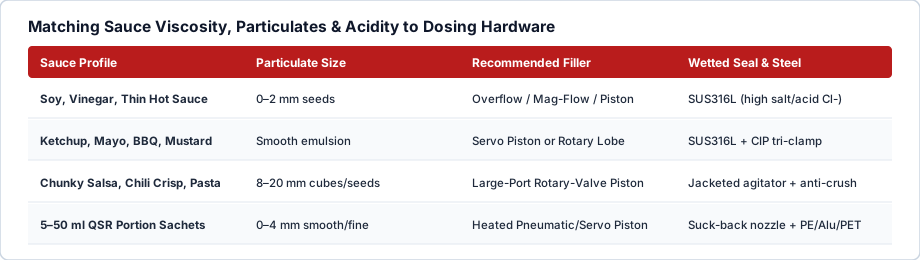
Simultaneously, solid particulates larger than 8–10 mm (diced tomatoes, jalapeño rings, whole peanuts, fermented black beans, mushroom slices) shear apart and score tight-clearance rotary lobe pumps—making large-bore three-way rotary-valve servo pistons mandatory for chunky sauces.
Sauce Process Window & Sanitary Design Reference
Critical thermal, mechanical, and metallurgical thresholds in condiment lines:
| Engineering Variable | Operating Threshold | Consequence If Ignored | Engineered Specification |
|---|---|---|---|
| Solid Particulate Size | >8 – 10 mm cubes/seeds | Crushed chunks + worn lobe rotors | Ø25–38 mm bore rotary-valve servo piston |
| Acid + Salt Corrosion | pH <4.2 with >2% NaCl | Pitting corrosion on SUS304 welds | Full SUS316L wetted path + Ra <=0.6 μm |
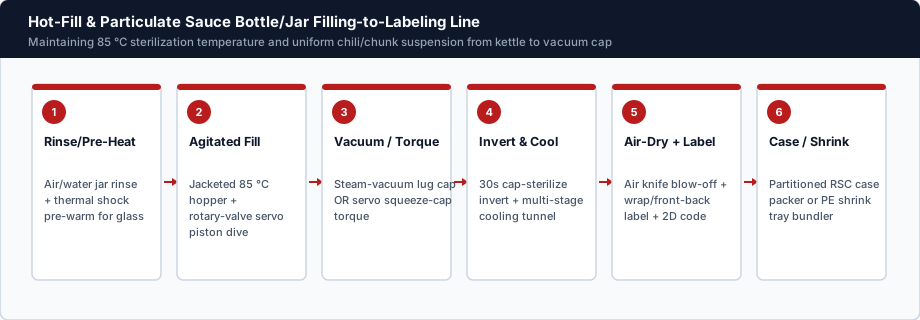
| Hot-Fill Temperature | 82 – 92 °C at nozzle | Standard PET paneling / seal swell | Heat-set PET or pre-warmed glass + PTFE seals |
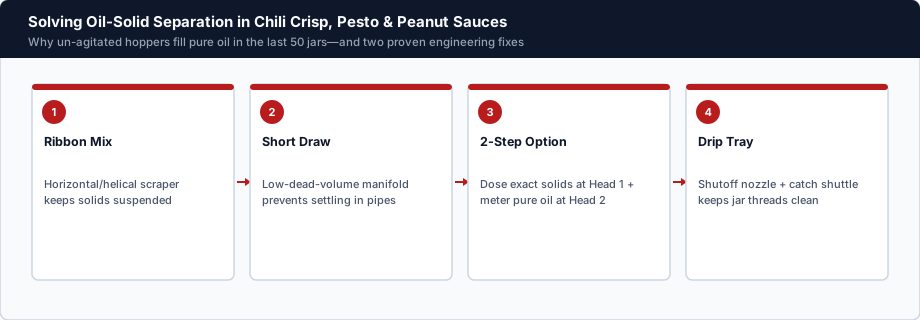
| Oil + Solid Suspension | 2-phase chili crisp / pesto | First jars all solids; last jars all oil | Horizontal ribbon agitator OR 2-stage fill |
| CIP Cleanover | Allergen swaps (peanut/sesame/soy) | 3-hour manual teardown | Tri-clamp quick-strip + 80 °C caustic CIP loop |
Size exact piston head count and hourly BPH for your sauce in our sauce filler nozzle and BPH calculator.
Sanitary Sauce & Hot-Fill Notes
- Bottom-Up Diving Servo Profile Stops Foam & Air Pockets: Soy sauce foams violently and thick mayonnaise traps ugly air voids against clear jar walls—servo diving nozzles start
10 mmabove the jar floor and rise in lockstep with the liquid meniscus. - Steam-Injection Vacuum Lug Capping (
38–82 mmTwist-Off): Injecting superheated culinary steam into jar headspaces microseconds before twisting on plastisol-lined metal lug caps pulls a crisp35–55 kPasafety-button vacuum upon cooling. - Insulated Double-Wall Safety Hoppers: Water/oil-jacketed hoppers hold sauce at
85 ± 1.5 °Cduring minor downstream pauses while rock-wool outer cladding keeps exterior stainless safe to touch (<45 °C).
Validate Your Sauce Formulation & Fill Temperature
Send pH, Brix/salt %, max chunk mm, and fill temp via Project Brief or explore sauce line sizing and buyer guides.
Explore related condiment systems in Sauce Packaging Machines, Hot-Fill & Viscosity Specs, or send your viscosity, chunk mm & BPH via Project Brief.