Four Questions Lock Your Sauce Dosing Physics in 60 Seconds
Choosing a pump solely by centipoise (cP) fails if your clear glass woozy bottles look unevenly filled on store shelves, or 12 mm jalapeño dices jam rotor lobes! Grounded in sauce line sizing and guides and hot-fill viscosity and sanitary specs, run your recipe through four filters: 1) Max solid chunk mm, 2) Viscosity cP at fill temp, 3) Cosmetic fill-level vs exact net-weight priority, and 4) CIP frequency.
Consult the definitive pump selection matrix below.
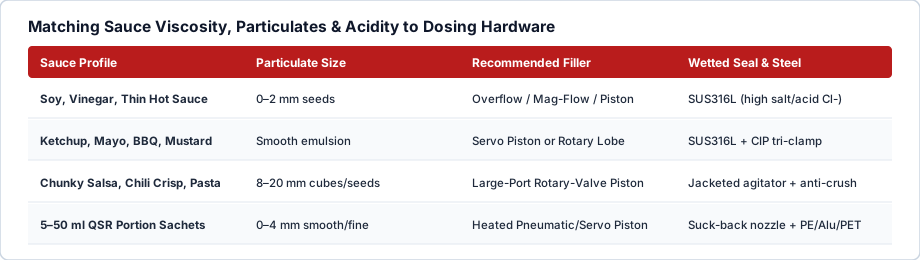
Sanitary Sauce Filler Technology Matrix
Quantitative limits across the four commercial condiment filling physics:
| Dosing Technology | Viscosity Range (cP) | Max Chunk Size | Accuracy / Fill Type | CIP Speed & Best Match |
|---|---|---|---|---|
| Rotary-Valve Servo Piston | 50 – 120,000+ cP | Up to 20–25 mm | ±0.2%–0.5% volumetric | 15-min clamp strip; universal paste/chunky |
| Servo Rotary Lobe Pump | 500 – 80,000 cP | <=4–6 mm soft only | ±0.5%–1.0% flow-timed | Fastest closed CIP; smooth ketchup/dressings |
| Cosmetic Level Overflow | 1 – 800 cP (free-flow) | 0–1 mm (filtered) | Exact visual neck level | Clear glass soy, vinegar, thin hot sauce |
| Electromagnetic Flowmeter | 1 – 15,000 cP (conductive) | 0–5 mm fine pulp | ±0.2%–0.4% valveless | Ultra-sanitary CIP; salty/acidic conductive sauces |
Read the full mechanical comparison in our piston vs lobe vs overflow sauce filler guide.
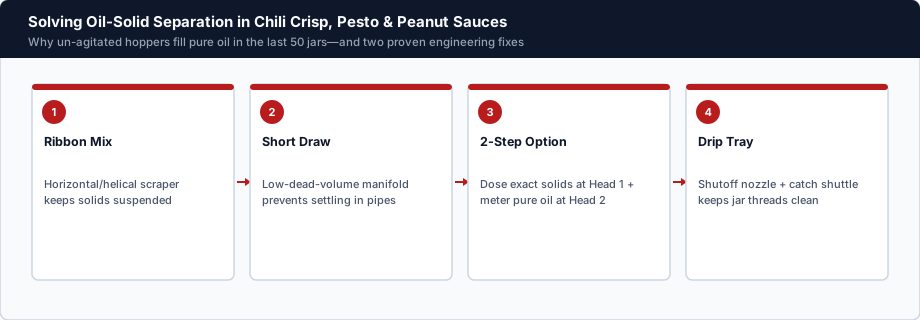
Sanitary Sauce & Hot-Fill Notes
- Why Clear Glass Woozy Bottles sometimes Favor Overflow: Blown glass 5 oz woozy bottles vary
±3–5 mlin internal glass wall thickness—a volumetric piston puts exactly148 mlin every bottle yet liquid heights look uneven on store shelves, whereas an overflow nozzle leaves identical visual fill levels! - Electromagnetic Flowmeters Require Electrical Conductivity (
>=5 μS/cm): Salted soy sauce, brine marinades, and ketchup conduct beautifully for valveless mag-flow meters—pure chili oil or olive-oil vinaigrettes have zero conductivity and require servo pistons! - Nozzle Shutoff Placement (
TipvsManifold): Always specify tip-shutoff anti-drip plungers right at the nozzle exit—shutting off 400 mm back at the valve leaves a dripping column of sauce in the hose.
Verify Your Recipe Against Our Pump Lab Data
Send viscosity, conductivity/oil %, max chunk size, and bottle material via Project Brief.
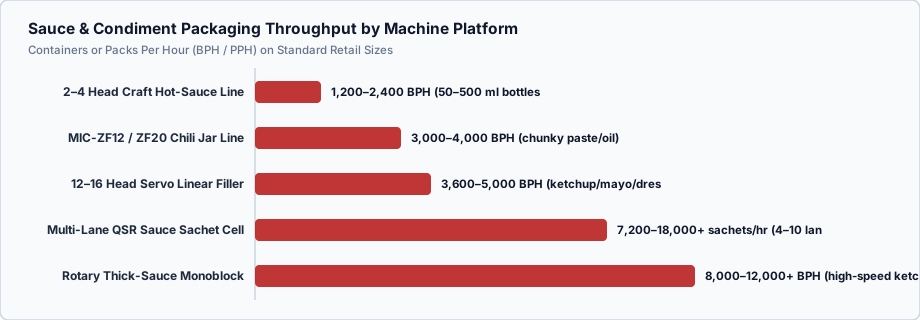
Explore related condiment systems in Sauce Packaging Machines, Hot-Fill & Viscosity Specs, or send your viscosity, chunk mm & BPH via Project Brief.