Choosing the Right Pump Physics for Smooth, Chunky & Water-Thin Sauces
Buyers researching condiment equipment constantly hear conflicting advice between servo piston, rotary lobe, and gravity/pressure overflow fillers. Grounded in sauce line sizing and guides and hot-fill viscosity and sanitary specs, the physics are clear: solid chunks above 8–10 mm belong on rotary-valve pistons, smooth high-SKU CIP emulsions shine on servo pistons or rotary lobes, and water-thin clear-glass sauces (<800 cP) shine on overflow or mag-flow.
Compare all five engineering dimensions side by side below.
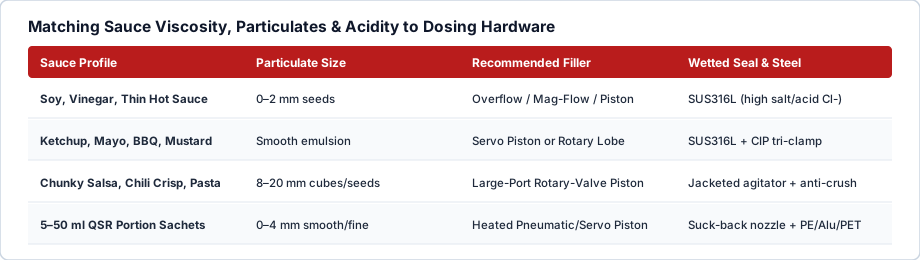
Servo Piston vs Rotary Lobe vs Overflow Comparison
Direct technical comparison for culinary sauce manufacturers:
| Criterion | Rotary-Valve Servo Piston | Servo Rotary Lobe Pump | Pressure / Vacuum Overflow |
|---|---|---|---|
| Chunk / Seed Tolerance | Excellent (up to 20–25 mm intact) | Poor >6–8 mm (shears chunks & wears lobes) | None (clean thin liquids only) |
| Volume Accuracy | ±0.2% – 0.5% fixed displacement | ±0.5% – 1.0% (slips if viscosity shifts) | Cosmetic level (volume varies w/ glass) |
| Volume Span per Setup | 5:1 to 10:1 per cylinder set | Wide continuous (50 ml – 5 L via servo turns) |
Unlimited container volume! |
| CIP Cleaning Mode | CIP flush + 15-min O-ring inspection | 100% closed-loop inline CIP | Fast closed circulation rinse |
| 6-to-8 Head Capex | Moderate baseline (1.0×) | Higher (1.25× – 1.5×; 1 servo pump/head) | Lowest (0.75× – 0.9×) |
Run your exact viscosity and chunk size through our sauce viscosity and pump selector.
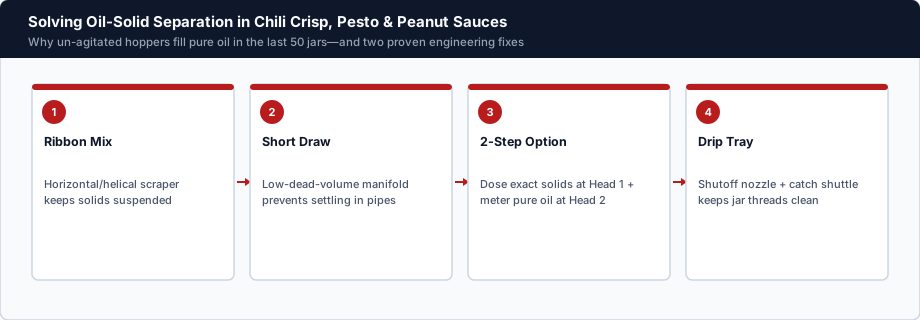
Sanitary Sauce & Hot-Fill Notes
- Why Hot-Fill Viscosity Drift Hurts Uncompensated Lobe Pumps: If kettle sauce cools from
88 °Cto78 °Cat the end of a batch, viscosity thickens and internal lobe slip changes—a positive-displacement servo piston displaces the exact same swept cubic centimeters regardless of cP drift! - Sanitary Rolling-Diaphragm / Peristaltic Niche: For micro-dose
5–30 mlartisan hot-sauce sample vials, peristaltic silicone tubing offers 60-second zero-cross-contamination flavor swaps between mild jalapeno and Carolina Reaper. - Combine Two Fillers on Multi-Category Co-Pack Lines: Co-packers running both thin soy marinades and chunky pasta sauces often mount a quick-bypass overflow rail alongside an 8-head servo piston on one shared conveyor.
Match Pump Physics to Your Full Recipe Roster
List your thinnest and chunkiest sauces via Project Brief.
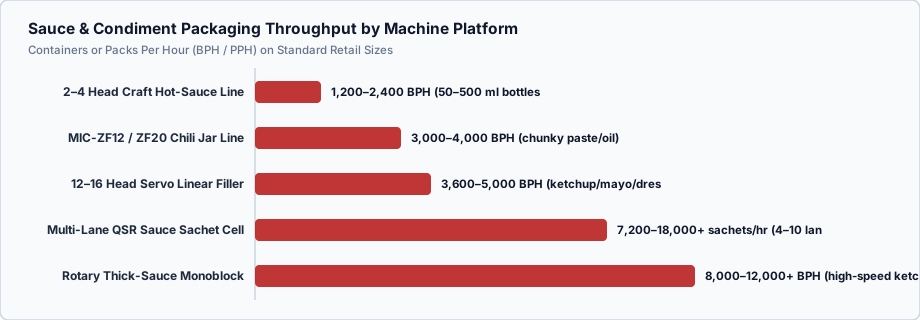
Explore related condiment systems in Sauce Packaging Machines, Hot-Fill & Viscosity Specs, or send your viscosity, chunk mm & BPH via Project Brief.